Kinetic Typography: The Mathematics of Motion
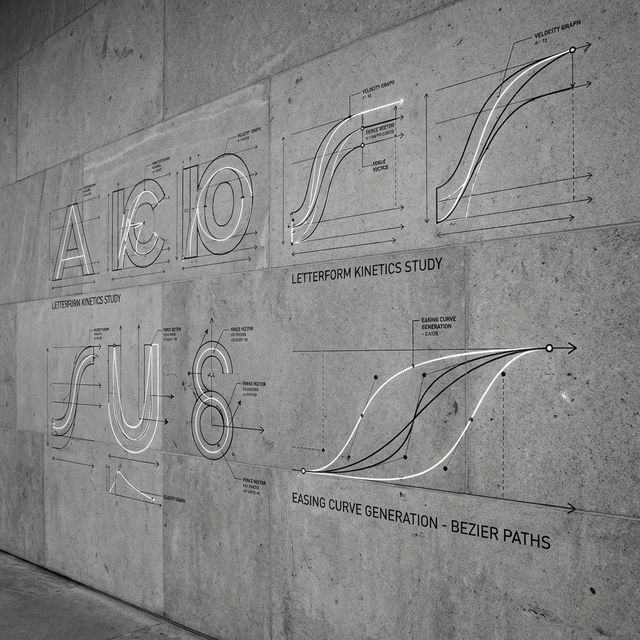
Typography on the web has traditionally been static, rooted in the legacy of print. But in a digital environment, time is a design dimension. When we combine the structural discipline of architectural engineering with the fluid physics of motion, we arrive at Kinetic Typography—fonts that don’t just sit on a grid, but react, breathe, and evolve.
The Foundation of Motion
At its core, great motion design is built on mathematical easing functions. Moving from point A to point B linearly feels robotic. To make an interface feel premium, we must simulate physical properties: mass, friction, and spring tension.
Easing as Engineering
Bezier curves are the blueprints of speed. By manipulating the control points, we define the “soul” of an interaction.
- Cubic Bezier (0.16, 1, 0.3, 1): This is the “Art Director” ease. It creates a high-velocity start with a languid, sophisticated deceleration.
- Spring Physics: Instead of fixed durations, we use stiffness and damping to calculate natural movement:
F = -k * x - c * v
Implementing Dynamic Type
Using libraries like Motion One or Framer Motion, we can orchestrate these animations across a grid. The key is Staggering. By offsetting the entry of each letter or line by a few milliseconds, we guide the user’s eye and create a sense of architectural depth.
// Example: Orchestrating a typography reveal
animate(
  ".title-char",
  { opacity: [0, 1], y: [20, 0] },
  { delay: stagger(0.05), duration: 0.8, easing: [0.16, 1, 0.3, 1] }
);
The Architectural Void
In kinetic design, what you don’t animate is as important as what you do. Leaving “voids” of silence between movements creates rhythm. It prevents the interface from becoming noisy and maintains the “grit and grace” aesthetic we strive for.