Generative Systems: Coding Chaos at Scale
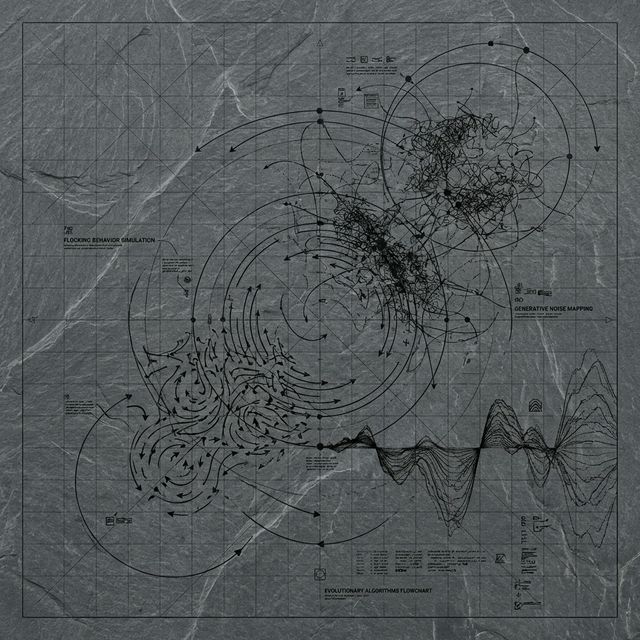
Generative art is the bridge between the deterministic nature of code and the beautiful entropy of the natural world. By implementing Generative Systems, we move away from designing static assets and toward designing engines that create infinite variations of beauty.
Harnessing Entropy
The core of any generative system is Noise. While Math.random() provides raw chaos, Perlin or Simplex noise provides “coherent” chaos—smooth, natural-looking transitions that mimic topography or fluid dynamics.
Flocking and Swarms
To create interfaces that feel “alive,” we often use Boid-style flocking algorithms. These involve three simple rules that result in complex, emergent behavior:
- Separation: Avoid crowding neighbors.
- Alignment: Steer toward average heading.
- Cohesion: Steer toward center of mass.
When combined with a physics engine like Matter.js or Rapier, these swarms can react to user mouse movements or “magnetic” attractors on the screen.
// A simplified attractor behavior
const force = displacement.normalized().multiply(G * mass1 * mass2 / distanceSq);
body.applyForce(force);
The Generative Grid
Even chaos needs a container. We use architectural grids to constrain generative output. Whether it’s a particle system confined within the “void” of a section or a kinetic typography system being distorted by noise, the contrast between structural order and algorithmic chaos is where the magic happens.
Scaling to the Web
Generative systems are computationally expensive. To maintain 60fps, we must optimize:
- GPU Acceleration: Offloading heavy math to shaders (GLSL).
- Worker Threads: Running physics simulations on a separate CPU thread.
- Instanced Rendering: Drawing thousands of particles in a single draw call.
By mastering these “Art Director” level techniques, we turn the browser into a high-performance canvas for generative discovery.